· 4 min read
How One Church Stopped Losing First-Time Givers by Automating Donor Follow-Up
A mid-sized church cut its first-time giver churn from 78% to 41% and grew recurring giving by 22%—here's exactly what they automated, what broke along the way, and what any church can copy.
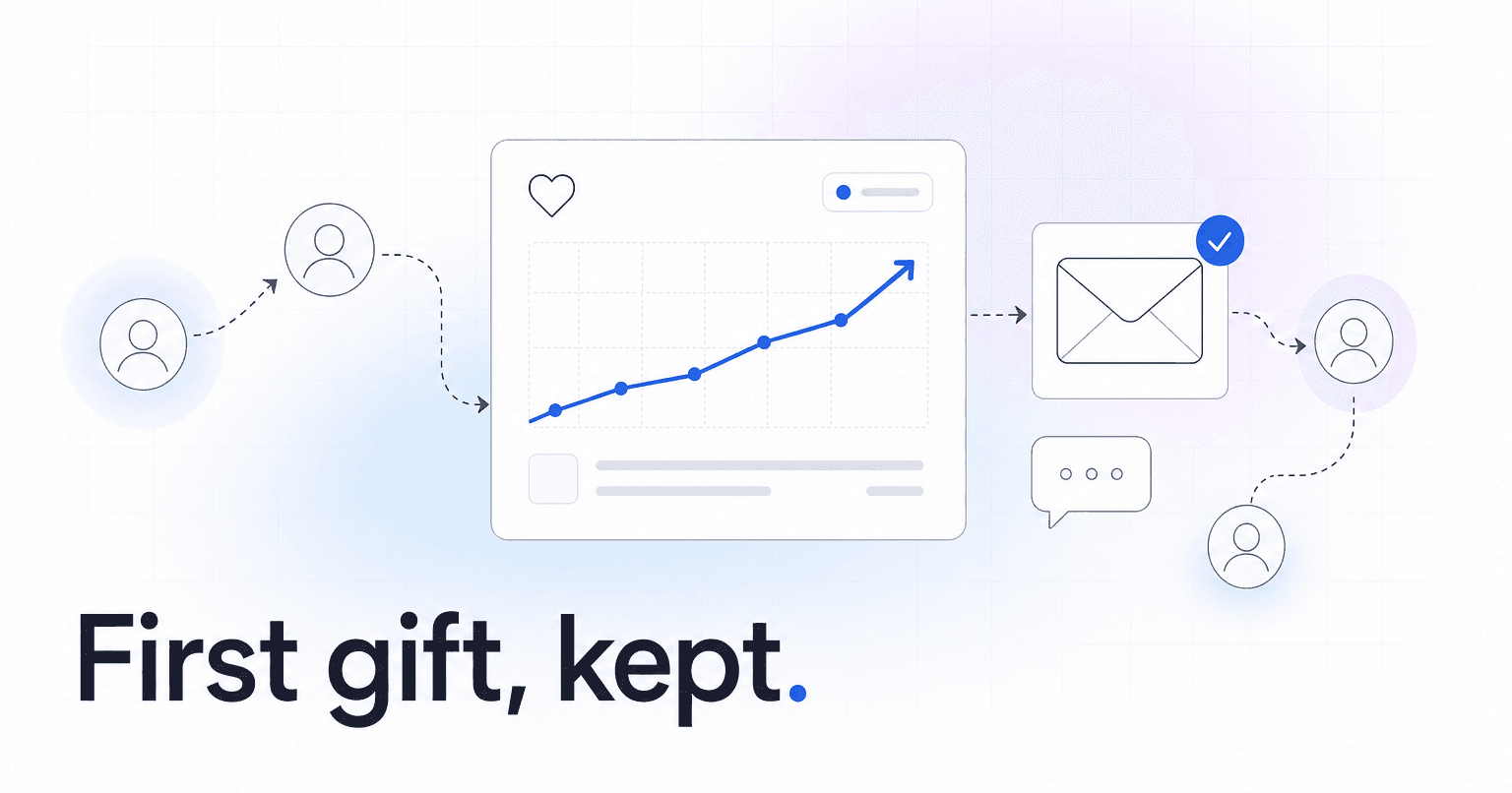
How one church stopped losing first-time givers by automating their donor follow-up process
A mid-sized church in the Midwest, roughly 850 in weekend attendance, was watching a pattern that quietly bleeds most congregations dry: about 78% of first-time givers never gave a second time. The finance team knew the number because they finally sat down and pulled it. Nine months later, after rebuilding their follow-up process around automation, that number dropped to 41%, and recurring givers grew by 22%. Here is exactly what they did, what broke along the way, and what any church can lift from it.
The situation: a leaky bucket nobody was watching
The church, we'll call them Grace Community, was running Planning Center for its ChMS, a separate email tool, a text platform for Sunday reminders, and a giving platform that emailed receipts automatically. On paper, follow-up existed. In practice, a first-time giver received one auto-generated tax receipt and then nothing. No thank-you from a pastor. No invitation to the next step. No acknowledgment that someone had trusted the church with money for the first time.
The executive pastor described it bluntly: "We were treating a first gift like a transaction, not a decision." The finance director could pull a report of new givers, but it took about 40 minutes each Monday, and by Wednesday the list was stale. When someone did try to call new givers, they had no context: was this a longtime attender who finally gave, or a visitor from two Sundays ago?
What they tried first (and why it stalled)
Their initial fix was manual. The finance director exported new givers every Monday, cross-referenced attendance in Planning Center, tagged pastoral staff in a shared spreadsheet, and asked each campus pastor to send a personal note within 72 hours.
It worked for about six weeks. Then a building campaign hit, staff got pulled, and the spreadsheet went two Mondays without an update. First-time givers from those weeks got nothing. When the team measured retention on that cohort a quarter later, it was worse than baseline, because the church had raised expectations with the earlier notes and then gone silent.
The lesson they took: any follow-up that depends on a human remembering to run it will fail the moment ministry gets busy. Which is always.
What they actually built
Grace rebuilt the process around three automated triggers, layered so a human touch still landed where it mattered most.
- Trigger one, within 24 hours of a first gift: an automated, personalized email from the lead pastor's address. Not a receipt. A short thank-you that named the giver, referenced the specific ministry area their gift supported, and included a two-minute video from the pastor. Open rates ran above 70%.
- Trigger two, day 4: a text message from the campus pastor's number asking a single question: "Anything we can be praying for you and your family this week?" Roughly 1 in 3 replied. Every reply routed to a real staff inbox, not a bot.
- Trigger three, day 14: an invitation tied to where the giver was in their journey. First-time visitors got a newcomer lunch invite. Longtime attenders got an invite to a vision night or a serve team conversation. The system picked the right path using attendance history and group involvement already sitting in Planning Center.
The finance team also set up a weekly digest showing which new givers had, and had not, been personally contacted, so nobody fell through when automation flagged someone as needing a human.
The result, with real numbers
Nine months in:
- Second-gift rate rose from 22% to 59%.
- Average time from first gift to second gift dropped from 94 days to 38.
- Recurring giving grew 22%, with the largest share coming from givers who had made their first gift in the previous 12 months.
- Staff time spent on donor follow-up dropped from an estimated 6 hours a week to under 90 minutes, most of it spent on personal replies the system had surfaced.
The finance director summarized it this way: "We stopped asking staff to remember. We asked the system to remember, and staff to show up."
The reusable takeaway
First-time givers do not churn because they regret giving. They churn because silence tells them the gift did not matter. The fix is not more effort from an already stretched team, it is a follow-up sequence that runs whether or not anyone thinks to run it, and that hands staff a short list of people who actually need a call.
This is the exact problem ChurchAI was built for: it sits on top of Planning Center, Breeze, or CCB, watches for new givers, triggers personalized follow-up automatically, and flags the handful of donors who need a human. If your church is losing first-time givers in the gap between the receipt and the second Sunday, that gap is closeable. Grace closed it in a quarter. See the platform overview or reach out through support to talk through what your own numbers look like.
Common questions
- What is ChurchAI?
- ChurchAI is an AI-native church management platform built to help churches retain members, grow giving, and eliminate administrative busywork. Unlike legacy church software that stores data passively, ChurchAI acts as an intelligence layer that connects to your existing tools, analyzes engagement patterns, predicts churn, identifies emerging donors and volunteer leaders, and automates follow-up workflows.
- How is ChurchAI different from Planning Center or other church management software?
- Most church management software like Planning Center, Rock CHMS, or Subsplash are built for administration and reporting. They store data but don't act on it. ChurchAI is built for discipleship and growth. It uses AI to proactively surface insights, predict which members are at risk of leaving, identify first-time and emerging givers, recommend volunteer candidates, and trigger automated follow-up communications. ChurchAI integrates with your existing tools and serves as the command center that turns church data into action.
- Does ChurchAI replace my current church software?
- No. ChurchAI connects directly with your existing church tools including Planning Center, Rock CHMS, Subsplash, Mailchimp, Microsoft Fabric, Power BI, and others. It acts as the intelligence layer on top of your current tech stack, unifying data from scattered systems into one command center without requiring you to switch platforms.
- What problems does ChurchAI solve for churches?
- ChurchAI solves three core problems: (1) Member churn — it identifies disengaged members early through attendance and engagement pattern analysis, then triggers automated follow-up before people fall through the cracks. (2) Missed growth opportunities — it surfaces emerging donors, first-time givers, and potential volunteer leaders that pastors would otherwise miss. (3) Administrative overload — it automates follow-ups, people management, growth tracks, and reporting so church staff can focus on ministry instead of spreadsheets.
- What size churches does ChurchAI work for?
- ChurchAI works for churches of all sizes, from growing congregations to enterprise-level megachurches with multiple campuses and complex tech stacks. The platform scales to handle multi-campus operations with thousands of members, multiple data systems, and sophisticated reporting needs.
- Is ChurchAI an AI chatbot for churches?
- No. ChurchAI is not a chatbot or a simple Q&A tool. It is a full AI-native platform with intelligent agents that analyze church data, score member engagement, predict behavior patterns, automate workflows, and deliver actionable insights. Think of it as an AI-powered Executive Pastor that monitors church health 24/7 and proactively surfaces what needs attention.
- What AI technology does ChurchAI use?
- ChurchAI uses AI-native architecture including large language models, engagement scoring models, predictive analytics for churn and giving patterns, and automated workflow agents. The platform's domain expertise is encoded directly into its AI workflows, prompts, and scoring models, built by founders with over a decade of church leadership experience. This creates a data flywheel where the more churches use ChurchAI, the smarter its predictions and recommendations become.
- How do I get started with ChurchAI?
- Visit churchai.com to request a demo. The ChurchAI team will walk you through the platform, understand your current tech stack and church needs, and show how ChurchAI integrates with your existing tools to deliver immediate value.